
What is BSc Optometry?
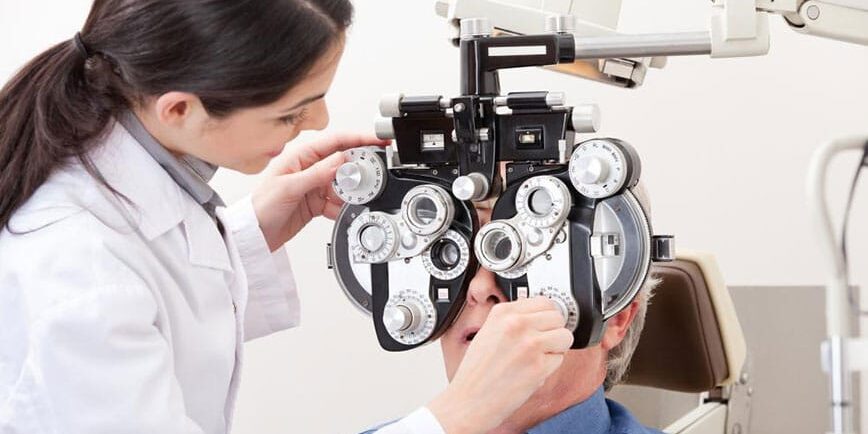
BSc Optometry is a full-time undergraduate Optometric course of 3 years which is divided into six semesters of study. BSc Optometry degree course includes the study of subjects like general physiology and ocular physiology, hospital procedures, low vision aids, geometrical optics, nutrition etc. The basic eligibility for the BSc Optometry course is a candidate who should have passed 10+2 or equivalent examination in the Science stream.
After completing BSc Optometry course, the graduates can join industries like Contact lens & ophthalmic lens industry, eye clinics, health consultancies, lens manufacturing units, optician showrooms, multinational companies dealing with eye care products, etc. They are often offered jobs like Optometrist, Optician, Sales Executive, Teacher, Eye Doctor, etc. Successful graduates candidates of the course enquiring in pursuing higher studies in the discipline may go for higher courses such as M.Sc., PhD and many other research-related studies in vision care science.
Why Study BSc Optometry?
There are plenty of reasons to study the BSc Optometry course. Most of the students prefer to study BSc Optometry course because of the following advantages they get:
- The students after graduating can become adept professionals through hands-on training and regular field visits up-skilling them in optometric practices, aspects of clinical optometry contact lenses, pediatric optometry and binocular vision eye diseases and treatments.
- The students will learn to participate in industrial safety programs, and work with road safety organizations and they can pursue their individual practice independently or can serve in government or privately managed organizations to contribute to the welfare of society.
- BSc Optometry degree serves as a basis for further higher studies in this field such as M.Sc., Ph.D. and M.Phil. Degree in Optometry, the successful completion of which makes one eligible for the post of a lecturer in any university/college.
- The scope for optometric practices in India and abroad is very wide and it is a dynamic and challenging career in which one could achieve personal growth and get respect from society.
- They can go for further higher studies and research work in the field of Optometry and take up the job of teacher/lecturer in several universities and colleges.
- After passing the course, they can establish an independent practice by starting their own eye clinic, optical shop, lens manufacturing unit,
What is the Admission Process for BSc Optometry?
Admission to the students in BSc Optometry course is granted based on the candidates’ performance in the entrance exam and according to the marks obtained in 10+2 level. Some universities also grant admission based on merit.
- Step 1: The candidates who are considering applying to this course at a particular college/university should check the eligibility and the kind of entrance exams conducted to shortlist the students.
- Step 2: Students can apply online or can visit the college to fill the application form which is necessary to apply for the course.
- Step 3: Give the entrance exam
- Step 4: Admission to BSc Optometry is granted based on the entrance exam and the application forms are made available in May and on the completion of the application form the universities and colleges start declaring their respective cut off which is the minimum required percentage for admission to BSc Optometry program.
- The cut-off list will be announced by the colleges and the shortlisted students are called for the next round of counseling as well.
- Step 5: Final Admission Round: For this course, the colleges conduct different rounds aiming to test the individual’s ability and skills through counseling.
Documents required for BSc Optometry admission
- Mark sheet and pass certificate of Class X or XII examination.
- Proof of date of birth.
- School leaving certificate
- Transfer certificate
- Domicile certificate/ residential proof or certificate
- Provisional certificate
- Character certificate
- Scheduled Caste/ Scheduled Tribe/Other Backward Caste certificates
- Proof of disability (if any)
- Migration Certificate
NOTE: – Every college issues a list of documents required make sure you have all documents on this list when you apply. Remember to take attested photocopies of all the above and don’t forget to take the amount to pay for fees in cash or demand draft with you.
BSc Optometry Eligibility
Students who aspire to seek admission to BSc Optometry course is required to follow the minimum eligibility criteria given below:
- The candidates must have completed their 10+2 from a recognized board of education with the minimum marks required.
- The minimum marks required for admission into BSc Optometry courses may vary from institute to institute, but the students are expected to have at least 50% in PCB/PCM/PCMB group. Check
- Some reputed colleges and institutes also conduct BSc Optometry entrance examinations to take admission to the degree course.
- The aspirants appearing for 10+2 examinations can also apply for this course, but they need to produce their exam scores at the time of counseling (with at least 50% marks aggregate required in the Science stream). Selection to the BSc Optometry course in the colleges is based on marks secured in the final merit i.e. total marks aggregated in the final exams of 10+2 and the entrance exam.
- The candidates should have attained the age of 17 years on the first November of the year of admission. There is no maximum age limit.
What is the BSc Optometry Entrance Exam?
Institutes depend on entrance exams majorly for admission in BSc Optometry course. The top well-known university, state and national level BSc Optometry entrance exams are mentioned in the table below.
| Entrance Exam | Registration Date | Exam Date |
|---|---|---|
| JET | May 19, 2022 | June 23 – 30, 2022 |
| NPAT | December 23, 2021 – June 20, 2022 | April 1 to June 26, 2022 |
| BHU UET | Feb 7 – March 18, 2022 | May 16 – 27, 2022 |
| SUAT | Fourth Week of May | To be Announced |
| CUET | May 27 – 31, 2022 | July 8, 2022 |
How to Prepare for the BSc Optometry Entrance Exam?
One of the most important steps to crack the entrance exam is to study dedicatedly as per the latest exam pattern and syllabus. The students giving the entrance exams for the BSc Optometry course need to prepare for four subjects mainly i.e., Physics, Chemistry, Biology, and Mathematics.
- The main points to keep in mind while preparing for the Entrance Exams:
- The students must devote at least 2-3 hours each day to prepare for the exam in a dedicated way.
- The students should refer to the latest test papers and by solving them, they will be able to understand the course content and the latest style of the entrance exam as well.
- They should attempt mock test papers to understand their mistakes, weaknesses, and strong points.
- They should have enough time to focus on the revision part as well; focusing only on the stronger sections while leaving the weaker sections might impact the performance greatly.
- Effective time management is very important to qualify an entrance exam like an expert.
How to get Admission to a Good BSc Optometry College?
There are a number of institutes in the nation that offer BSc Optometry programs. To help understand how to secure a seat in a top-ranked college, the following tips can be read through.
- Students have to keep in mind that they need to start planning early. By planning early, they can start studying for their respective entrance exams, as well as the final exams for their 10+2.
- Keeping track of application dates, examination dates etc. is necessary. It is easy to miss any changes in the dates. Access the university’s website for all updates.
- The research proposal must be revised and prepared with care and the material must be known inside and out.
- It is also very important for a student to be prepared both mentally and physically for further rounds after the entrance test i.e. counseling/personal interview. They need not to be stressed while preparing for the examination.
- Candidates should watch out for the best colleges to pursue the B.Sc. course and move ahead with their preparation accordingly.
BSc Optometry Syllabus
The BSc Optometry course curriculum is designed in such a way that it covers all the important aspects to train the students to make a career in the optometry industry. The BSc Optometry duration is divided into 6 semesters of study.
A semester wise breakup of BSc Optometry syllabus is given below in the table listing the important subjects:
| SEMESTER 1 | SEMESTER 2 |
|---|---|
| Basic Accountancy | Contact Lens |
| Clinical Psychology | Functional English and Communication |
| Community and Occupational Optometry | Geriatric Optometry and Paediatric Optometry |
| Computer Basics | General Biochemistry & Ocular Biochemistry |
| SEMESTER 3 | SEMESTER 4 |
| General Physiology and Ocular Physiology | Hospital Procedures |
| General Anatomy and Ocular Anatomy | Low Vision Aids |
| Geometrical Optics | Mathematics |
| Hospital Procedures | Nutrition |
| SEMESTER 5 | SEMESTER 6 |
| Ocular Diseases and Eye & Systemic Diseases | Physical Optics |
| Optometric and Dispensing Optics | Public Relations |
| Optometric Instruments and Clinical Examination of Visual System | Research Methodology and Statistics |
| Pathology & Microbiology | Squint and Binocular Vision |
| Pharmacology | Visual Optics |
BSc Optometry Books
Tabulated below are some of the important BSc Optometry books.
| Name of the Book | Author |
|---|---|
| Optometric Optics: Clinical Optics | Troy Fenin |
| Physical & Geometric Optics | Micheal Keating |
| Ocular Diseases | Kanski and Parson |
| Binocular Vision | Edith Pearlman |
| Contact Lenses | Ken Daniels |
Top BSc Optometry Colleges
A significant number of top universities/colleges across the country offer a BSc Optometry course to candidates who have successfully passed class XII examinations from a recognized board. Some of the top BSc Optometry colleges in India are given below.
| College | City | Fee Structure |
|---|---|---|
| Teerthanker Mahaveer University | Moradabad, Uttar Pradesh | INR 76,400 |
| Centurion University of Technology and Management | Bhubaneswar, Orissa | INR 90,000 |
| Jawaharlal Institute of PostGraduate Medical Education and Research | Pondicherry | INR 3,760 |
| DY Patil University | Navi Mumbai, Maharashtra | INR 1.10 Lakh |
| Pt. Bhagwat Dayal Sharma Post Graduate Institute of Medical Sciences | Rohtak, Haryana | INR 12,395 |
| JSS Academy of Higher Education and Research | Mysore, Karnataka | INR 1.04 Lakh |
| Karunya Institute of Technology and Sciences | Coimbatore, Tamil Nadu | INR 1.05 Lakh |
| Hamdard Institute of Medical Science and Research | New Delhi, Delhi NCR | INR 2.04 Lakhs |
| CMJ University | Ri-Bhoi, Meghalaya | INR 65,000 |
| Royal Global University | Guwahati, Assam | INR 1.01 Lakh |
| Dr. M.G.R Educational & Research Institute | Chennai, Tamil Nadu | INR 1.40 Lakh |
BSc Optometry : College Comparison
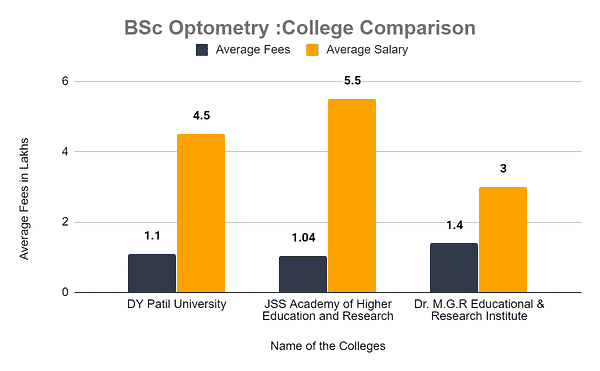
The comparison of the top three BSc Optometry colleges is given below in a tabular form along with their average annual fees, and average placement package offered:
| Parameter | DY Patil University | JSS Academy of Higher Education and Research | Dr. M.G.R Educational & Research Institute |
|---|---|---|---|
| Overview | DY Patil International University, [DYPIU] Pune was established by the Maharashtra State Government and has recently become operational as a State Private University. The University is approved by UGC and is one of the units of DY Patil Group. DYPIU, Pune courses include B.Tech, M.Tech, B.Sc., B.Com, BBA, BCA, BA and PG diploma programs. The University believes in giving world-class education with long-standing commitment towards quality teaching and learning. It aims to aspire and create experimental learning. | JSS Medical College, Mysore provides various undergraduate, postgraduate and doctoral programs. The JSS Medical Colleges admission is offered for undergraduate and postgraduate courses in medicine. They have experienced and qualified staff, a well-equipped library, laboratories and classrooms with modern teaching aids. It has an intake of 200 students for MBBS and about 20 medical specializations in MD/ MS. | Dr MGR Educational and Research Institute, Chennai is a constituent of Tmt. Kannammal Educational Trust. MGRERI is a Deemed University in 2003 as per UGC and MHRD, New Delhi. It is accredited with ‘A’ Grade by NAAC and approved by the NBA. It facilitates undergraduate and postgraduate courses. The college has good infrastructure and good surroundings. The college has the well-equipped classrooms which are efficient to deliver top-class infrastructural facilities to the students. |
| NIRF 2020 ranking | 101 | 54 | 151 |
| Location | Navi Mumbai, Maharashtra | Mysore, Karnataka | Chennai, Tamil Nadu |
| Admission process | Entrance exam | Entrance exam | Entrance exam |
| Average annual fees | INR 1.10 Lakh | INR 1.04 Lakh | INR 1.40 Lakh |
| Average annual package | INR 4.5 Lakhs | INR 5.5 Lakhs | INR 3 Lakhs |
| Top recruiters | Quick Heal, Wipro, TATA Technologies, Pin Click, Swiggy, Capital First Limited, Reliance Life Sciences etc. | Sunpharma, Strides, AstraZeneca, Novartis, Himalaya, Milan, Micro labs etc. | Infosys, IBM, TCS, L&T, Caritor, Accenture, Satyam, Wipro, etc. |
BSc Optometry Vs B. Optometry
B. Optometry and BSc Optometry are two most popular bachelor degree programs in the Optometry field. Bachelor of Optometry is more of a professional course and the objective of BSc Optometry course is focusing more on studying the field theoretically.
The major differences between these two courses are given in the table below on the basis of fees, admission process, salary and so on.
| Parameters | BSc Optometry | B. Optometry |
|---|---|---|
| Full Form | Bachelor of Science in Optometry | Bachelor of Optometry |
| Level of Study | Undergraduate | Undergraduate |
| Duration | 3 years | |
| About | The Bachelor of Science in Optometry course provides an extensive training and medical knowledge about the human eye. | It’s an undergraduate degree which will give you an in-depth knowledge of the working of the eyes and the treatment of the same in cases of inflictions. |
| Eligibility | 10+2 in PCBM completed from a recognized board of education | 10+2 in PCMB with a minimum of 50% aggregate. |
| Admission Process | Entrance exam followed by a counselling | Direct admission |
| Average Course Fees | INR 10,000 to 1 Lakh | INR 15,000 to INR 1.5 Lakh |
| Job options | Optometrist, Optician, Sales Executive, Teacher, Eye Doctor, etc. | Optometrist, low vision specialist, orthoptist, optician etc. |
| Average Starting Salary | INR 2.5 Lakhs to 8 Lakhs | INR9 Lakhs |

What after BSc Optometry ?
An BSc Optometry graduate has ample opportunities waiting around, all one needs to do is to grab it. All of this is because of the diverse skill set one possesses.
There are many job opportunities for BSc Optometry graduates. The students become eligible enough to get job opportunities in various private and public sectors in relevant sectors.
They can find jobs in lens manufacturing units, optician showrooms, multinational companies dealing with eye care products, etc.. Some of the posts are Optometrist, Optician, Sales Executive, Teacher, Eye Doctor, etc. The salary of the graduates depends on various factors including experience, skills and job profile.
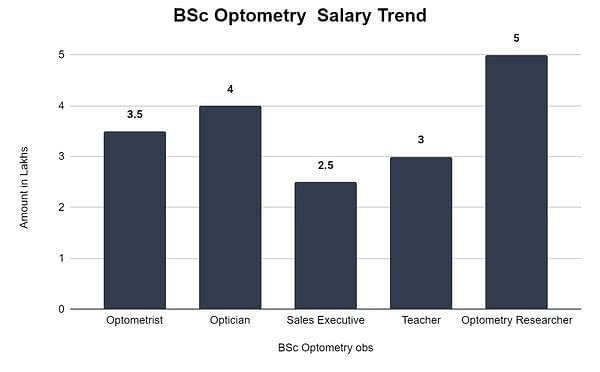
Some of the popular jobs available to a BSc Optometry graduate along with the corresponding salaries are provided in the table given below:
| JOBS | DESCRIPTION | AVERAGE ANNUAL SALARY |
|---|---|---|
| Optometrist | Optometrist is a healthcare professional who specializes in the eyes and they conduct vision exams and diagnose the conditions based on exam results and then they also determine the course of treatment for said conditions. | INR 3.5 Lakhs |
| Optician | A technician who verifies the prescription given by an eye doctor and who is trained to correct lenses according to the eye defect, advise patients on any necessary repairs or adjustments, maintain displays, and works with sales professionals from vision care suppliers. | INR 4 Lakhs |
| Sales Executive | Sales executives promote products and services for customers and negotiate contracts with the aim of maximising the profits. | INR 2.50 Lakhs |
| Teacher | A teacher’s responsibility is to develop curriculum and lesson plans, and present those lessons to their students, individually or in groups and they track the progress of their students and create reports to inform students’ parents about their progress. | INR 3.01 Lakhs |
| Optometry Researcher | Optometry researcher duty is to research about different ailments affecting eyes and how to treat them. | INR 5 Lakhs |
What is the Future BSc Optometry Scope?
This degree course enables the students to go for various optometry jobs and they can establish an independent practice by starting their own eye clinic, optical shop, lens manufacturing unit etc. A graduate of BSc Optometry will find that there are many scopes in today’s market.
These professionals can assist ophthalmologists in hospital clinics, practice in optical establishments, run optical shops, and have excellent job opportunities overseas.
They can offer clinical services to multinationals dealing with companies, with the manufacturing and distribution of ophthalmic lenses, contact lenses and ophthalmic instruments. BSc Optometry graduates can also start manufacturing units for optical lenses.
Lastly, the students who are interested in higher studies can join for MSc and PhD. programs in the relevant field and can take up teaching as a career